|
Comics and Music
various reviews by Mike Baron The Escapist 1 Written and drawn by various creators, 80 pages Publisher: Dark Horse Comics, Price: $8.95 US Most comic fans know about Michael Chabon's Pulitzer-prize winning novel, The Amazing Adventures of Kavalier and Clay, which lovingly recreates the dawn of the age of comics. In the book Chabon chronicles the birth of Kavalier and Clay's breakthrough character, The Escapist. Inevitably, here is the comic. Chabon's concept was that The Escapist, like Captain Marvel, has undergone numerous changes at the hands of numerous publishers. The book purports to present stories from all those eras which Chabon outlines in his introduction and in "Escapism 101." 
© 2004 Dark Horse Comics The faux history, designed to capture the flavor of the pulps, is more entertaining than most of the stories. The first issue succeeds mainly on the strength of Chabon's origin story, beautifully illustrated in an Alex Toth-influenced style by Eric Wight. "The Passing of the Key" is taut, moving and effective. Wight's art is square-jawed and clean. The whole story is square-jawed and clean, but never dumb. Jim Starlin's "Reckonings" is a near-wordless story of Luna Moth, who in Starlin's hands is a somewhat terrifying creature. Those giant, upswept demon eyes deny her humanity while her overblown carnality screeches her femininity. Think manga female, then think the opposite. Geez, Jim. This is enough to turn a schoolboy off girls. As in most wordless stories, it takes a nanosecond to read, but Starlin actually has a story here, and there's a pay-off. He has also managed to incorporate his life-long themes of man/woman/life/death/infinity. If this were to appear in a Jim Starlin anthology it would be of a piece with the other stories. Consulting Editor Kevin McCarthy, Chabon's factotum, contributes "Sequestered," a funny story in which the Escapist is called for jury duty. Kyle Baker's loosey-goosey art captures the feel of old Mad magazines, particularly Jack Davis and George Woodbridge. McCarthy's premise is better than his execution. When it turns out that the Iron Chain is railroading an innocent man merely to degrade faith in the justice system, my reaction was, Huh? Wouldn't they be more effective simply committing crimes and getting away with them? McCarthy never explains why the defendant was discovered crouched over the body with knife in hand. Howard Chaykin contributes "Are You Now Or Have You Ever Been," a cautionary tale about Senator Joe McCarthy. This "Senator McCraven" is a sex addict with a yen for domination. The Escapist and crew blackmail the Senator to get him off their backs. Inevitably, there is the Chaykin drawing of a gorgeous woman tied spread-eagled to a cross. As Lincoln said, if you like this sort of thing, this is the sort of thing you will like. Chaykin's chops are fine as ever but the story smacks of padding, several pages of huge talking heads that could have been profitably condensed. Finally, McCarthy contributes "Prison Break" with art by Steve Lieber. The Escapist breaks into prison to discover the fate of a Golden Key informant who has stopped broadcasting. Turns out the guy joined the Iron Chain. If the Golden Key can't choose their agents more effectively than this they don 't deserve to be in business. I give McCarthy credit for having the Escapist shout, "UF DA!" Full disclosure: when I heard there was going to be an Escapist comic I wrote Michael Chabon and he invited me to contribute. My story is in the second issue. It's called "300 Fathoms Down" with art by Val Mayerik. Iron Fist 1 Writer: James Mullaney Artist: Kevin Lau Publisher: Marvel Comics, Price: $2.99 US Crap. What used to be called "it's just a comic book" where nobody thinks about the character or takes anything seriously. Blurb sez, "Yours are the most finely-honed Martial Arts skills in the world." Writer displays ignorance of martial arts as a badge of honor. Any twelve-year-old at Kim Yee's Karate West could choreograph better fight scenes than this. What is the point of declaring your hero a martial artist if the fight scenes consist of close-ups of a man's foot smashing another man's jaw? As if that constituted martial arts. 
© 2004 Marvel Comics There is a way to show martial arts with grace and excitement. Check out any of the Young Masters by Chuck Dixon or Val Mayerik, or Way of the Rat, for that matter. (Way of the Rat's martial arts don't compare to Young Master, but at least the moves flow logically and kinetically from panel to panel.) The art is a bastard hybrid of bad superhero and manga. The worst of both worlds. The splash page is the same as the cover. Trees died. Fans wept. Daredevil 57 Writer: Brian Michael Bendis Artist: Alex Maleev Publisher: Marvel Comics, Price: $2.99 US In the second part of The King of Hell's Kitchen, Daredevil has removed his mask and declared himself the title boy. Hordes of yakuza crawl out of the woodwork to disabuse him of that notion. The FBI stands pat, afraid to get involved. Bendis' writing is always good in the sense there are no false notes. This is the way people really talk. Ben Urich does all the talking here, describing Daredevil's terrific fight to a mystery visitor. 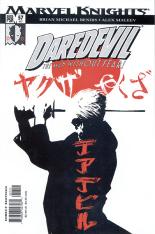
© 2004 Marvel Comics And that's part of the problem. Instead of showing the fight, Bendis and Maleev go for an impressionistic effect, throwing away several two page spreads on mood. The big crimson center-spread of a lone yakuza swinging a club is a particular waste. Once again we are given an ostensible martial arts expert and asked to take the writer's word for it. When Denny O'Neil edited Daredevil he advised Frank Miller to find a fighting style, which Miller did. He also choreographed the fights so that you believed Daredevil was a martial arts expert. Bendis and Maleev rally for a moment on page seven when Daredevil snaps the aerial off a car and uses it to whiplash an assailant. The book could have used more of this, more clearly shown. Maleev seems to be going for a gloomy, rain-ridden Bladerunner look with his overwrought textures. Didn't work for me. And for all the folksy dialogue, and the shocker on the last page, this story doesn't much work either. Marvel shoots themselves in the foot with their wretched ad placement. The splash page, no longer part of the story, consists of credits and recap. One page of Ben Urich talking facing an ugly ad on page three. Page three? Why not just put the ad on the cover? Why can't Marvel figure out their ad pages to be non-obtrusive like DC's? The Letter Aitch This year is poised to go down as one of the greatest in the history of pop music. You won't hear them on the radio. You won't see them on the MTV awards. But the pop underground is reaching critical mass, producing music of such beauty and power that the so-called record industry has two choices: embrace the pop underground or die. Frankly I hope it dies, and these independent garage bands, the spirit of pop, break out on their own, selling on their own labels. Which brings us to the letter 'H'. Last month I told you about Hindu Rodeo's new release Nalaadaloobr, their first since 1995. Not even Nostradamus could have guessed that Hindu's Minneapolis neighbors the Hang-ups, and Nova Scotia's answer to Brian Wilson the Heavy Blinkers would also produce new albums. Hindu Rodeo, Heavy Blinkers, Hang-ups. Add to them a new Rockfour album recorded in Detroit. Rockfour's previous release, A New Beginning, is a jaw-dropping celebration of early seventies' psychedelia, Byrds, 13th Floor Elevators, and bands of that ilk. Cry Aitch and loose the dogs of pop! Mike Baron is the creator of the award winning comic book Nexus and during his career has written an enormous variety of comics from The Flash to The Punisher. He is currently writing Faro Korbit for AP Comics, working on a Green Lantern novel for Byron Preiss, and is working on several projects destined to change the face of pop culture in his secret skunkworks. Visit our Comic Book News Archive. |